6 November 2026
The Pareto Principle Between Science and Spirituality
The Pareto Principle Between Science and Spirituality
Have you ever wondered whether this vast universe, in the middle of which each of us goes about our business, has a set of rules? Some regularity that holds.
And imagine for a moment what it would be like if you knew those rules. How much more precise your decisions would be.
A couple of years ago, in a mastermind group run by my good friend Roland Tokko, we were set the task of reading a book on the Pareto principle. I started reading, and somewhere in the middle it flashed: this is it. I had already studied this, just in an entirely different context.
That same principle lays out what ancient wisdom has known for thousands of years and what the mystery schools have taught — the universe is a hierarchically organised mathematical structure.
It only looks like chaos to us. Because we have no overview. But let’s look closer.
Science has no overview either.
Dr Theresa Bullard-White is a particle physicist and at the same time an Ipsissima of the Modern Mystery School and an experienced teacher. Someone standing in both worlds at once, in science and in spirituality. She has said that according to various scientific circles, roughly 93–97% of information is what we do not see.
We know it is there, because we can see its effect. We just cannot measure it yet.
Ancient traditions have worked with that same unseen for a very long time. They built no telescopes, they had no gadgets. There was a long tradition, a sharper perception and the capacity to analyse, and that was enough. They studied how this order is built and how to relate to it.
A pattern you already know
This is where that practical example of hidden order from the business world comes in, one so familiar that nobody even stops at it.
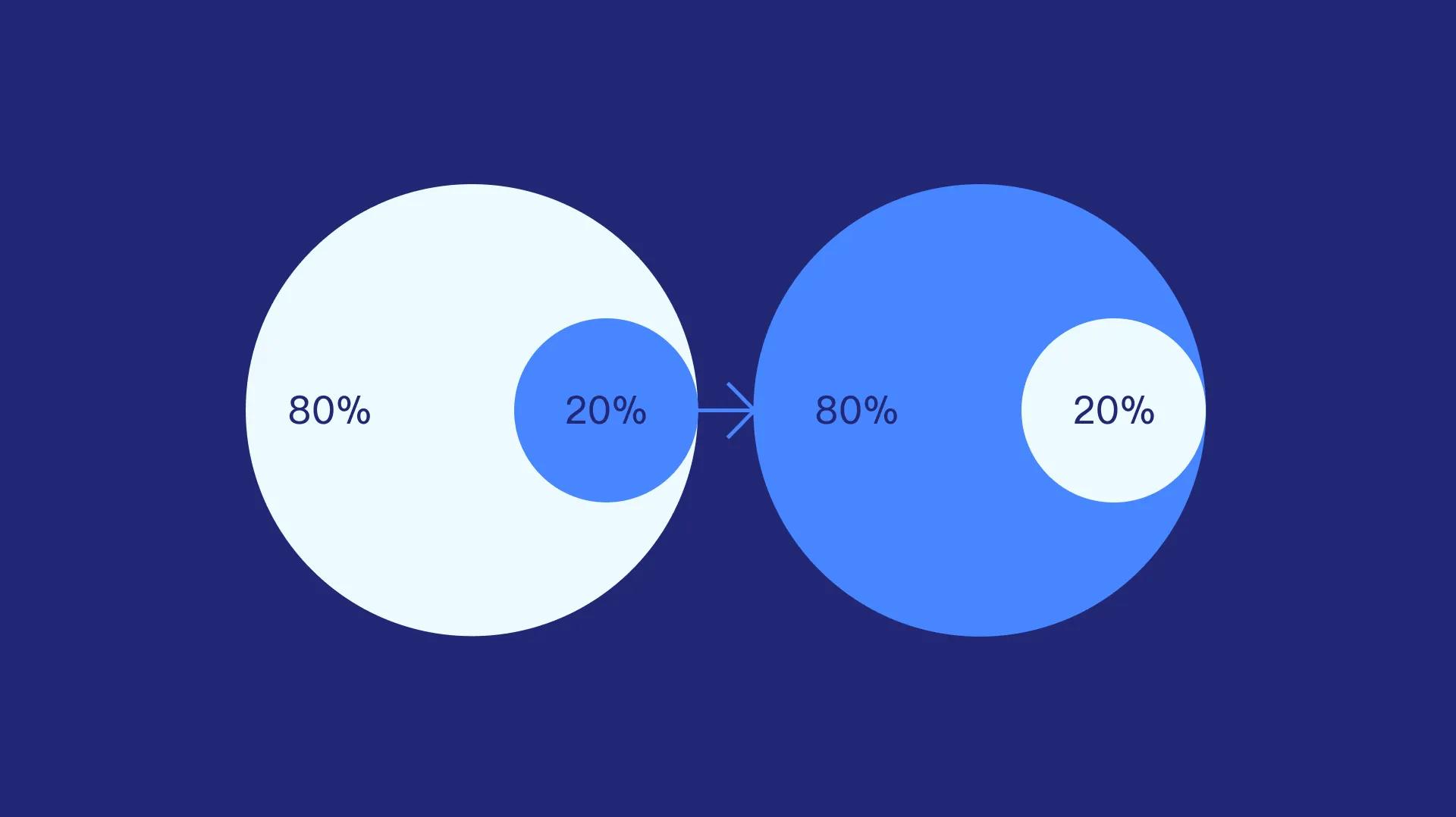
In 1896 the Italian economist Vilfredo Pareto notices that around 20% of the population owns around 80% of the land. He checks other countries. The same pattern. Nearly fifty years later, the quality management expert Joseph Juran brings it into business and renames it in Pareto’s honour. That is where the name comes from that you may have heard in a meeting.
That same Pareto principle appears in places that have nothing whatsoever to do with one another.
City sizes within a country. The magnitude and frequency of earthquakes. Word frequency in every language. Book sales figures. Citation counts for scientific papers. Links to web pages. The extent of forest fires. The distribution of wealth in almost every society throughout history.
Language and earthquakes share no mechanism, forests and book sales know nothing of each other. And yet the same curve comes out.
Science is not empty-handed here. Several mechanisms are known that produce this kind of distribution. Preferential attachment — whoever already has a lot gets more more easily; this is how networks grow and how wealth grows. Self-organised criticality — Per Bak’s sandpile model, where the pile builds itself into a state in which a single grain can trigger an avalanche of any size. Multiplicative processes under constraints. Each of these has been worked through mathematically.
But a question remains here that none of them resolves.
Why is there a pattern that unrelated systems move towards?
Science has no single answer to this. I have found my answer elsewhere.
Having studied for many years in the ancient King Solomon lineage, I have come to understand that the world around us is organised very precisely, on very high levels. Pure mathematics and sacred geometry.
But organised how? On the basis of hierarchies. Multidimensionally, through a great many hierarchies at once.
This is visible in the simplest places too. The lineage I study in is itself a hierarchy whose levels are earned. The career ladder, training at the gym, management systems — these are all hierarchies. I was once a big Android fan; today I have used an iPhone for years. That too is my personal preference within the hierarchy of phones, where I have placed the iPhone higher. When I am focused, I prefer calmer background music. Again, my own inner hierarchy.
And of course that same Pareto principle. For me it is explained by the unseen side not being an undifferentiated soup, but being organised into hierarchies itself.
Why should I care?
If the universe is highly organised, and we want to live our own lives well and in an organised way, how do we get there?
We humans are curious creatures, highly susceptible to chaos. Try doing nothing for a week and lounging on the sofa in front of the TV.
The dishes pile up, the body depreciates, the air turns thick. Nobody did anything wrong. Somebody simply did not do anything at all.
Order is paid for with work, in the kitchen as much as inside yourself. The second law of thermodynamics says the same: a system moves towards disorder on its own, and holding order in place requires an inflow of new energy.
So in order to see deeper and to keep up with the development of the universe, we have to work constantly. The work of the material world is clear to us. But what about the spiritual world?
Here those same long-standing traditions and ways come to our aid, the ones that have always worked. Sessions to let go of what we no longer need. And trainings to open more and more new potential, and to move towards greater order and best versions ourselves.
Coming back to the question: how much more precise would your decisions be if you knew the rules, and could navigate the various hierarchies as well as possible?
I do not know how much. But I do know that the more work you do on yourself, the more it becomes possible to settle into deeper cooperation with that order, and to keep yourself further from chaos. The only open question is whether you are ready to do that work.